Walk along the beachfront promenade in Sanur at sunrise and you will see them everywhere: small, intricately woven palm-leaf trays brimming with colourful flowers, a curl of incense smoke rising from each one. They rest on temple shrines, shop doorsteps, hotel entrances, and even the dashboards of taxis. These are canang sari, the daily offerings that form the heartbeat of Balinese Hindu life, and learning to make one is among the most quietly profound cultural experiences a visitor to Sanur can have.
This guide explains what canang sari truly is, the deep symbolism woven into every component, how the offerings are made, the philosophy behind the daily ritual, and where you can learn the sacred art of canang making yourself, including at The Meru Sanur on Sanur’s tranquil sunrise coast.
Canang Sari: Bali’s Daily Offering, Explained
- Philosophy: The sheer frequency of daily offerings reflects a worldview in which the spiritual and everyday worlds are deeply intertwined, not separated.
- What It Is: Canang sari is the simplest and most frequent Balinese Hindu offering — a small woven basket of flowers, rice, and other elements.
- How It’s Made: Making canang sari is a craft, a meditation, and a daily discipline rolled into one.
- Where You’ll See It: Canang sari appears outside homes, shops, and temples throughout Sanur, placed fresh each day.
- Etiquette: Because offerings are placed with real intention, visitors are generally asked to step around rather than over them.
What Is Canang Sari? The Meaning Behind Bali’s Daily Offering
Canang sari is the simplest and most frequent of all Balinese Hindu offerings: a small woven basket of flowers, rice, and incense presented daily as an act of thanksgiving. The name itself reveals its purpose. Canang comes from two syllables in the old Kawi language, ca (beautiful) and nang (purpose), while sari means essence. Together, canang sari translates to something like “the essence of a beautiful purpose,” a gift of beauty offered with sincere intention.
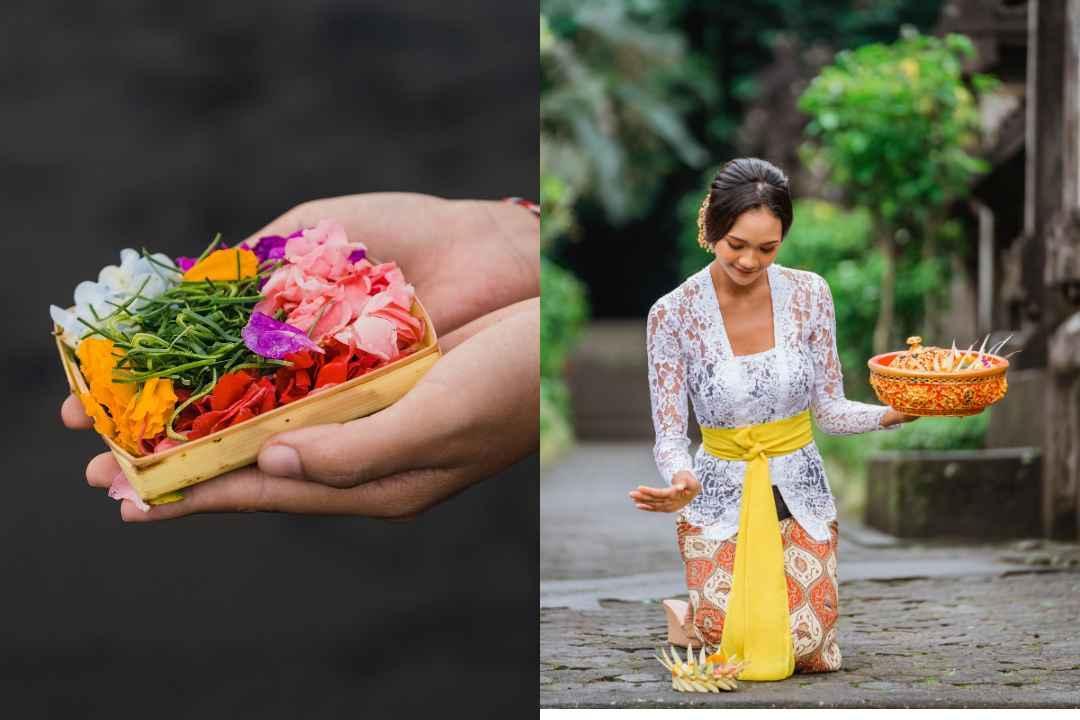
The offering is made each day to honour Sang Hyang Widhi Wasa, the supreme God in Balinese Hinduism, and the Dewata Nawa Sanga, the nine guardian deities of the directions. It is, at its core, an expression of gratitude, a daily thank-you for the peace and balance granted to the world. More than that, canang sari embodies the central Balinese philosophy of Tri Hita Karana, the “three causes of well-being,” which holds that happiness flows from harmony in three relationships: between humans and the divine (parahyangan), between humans and one another (pawongan), and between humans and nature (palemahan). Made from natural materials, prepared with family, and offered to the gods, each canang quietly nurtures all three.
The simplest offering is also the most common one you’ll see
Canang sari — a small woven basket of flowers, rice, and other elements — is deliberately the simplest of Balinese Hindu offerings, which is exactly why it’s the one visitors encounter constantly outside homes, shops, and temples.
Recognizing it for what it is, rather than mistaking it for decoration or litter, changes how a visitor reads the streets of Sanur on a daily walk.
The Sacred Symbolism Inside Every Canang
What looks at first like a pretty arrangement of petals is in fact a precise, symbolic composition, a model of the cosmos in miniature. Almost every element carries meaning.
The base is the ceper, a small square tray, often around 10 centimetres, woven from young coconut leaves (janur). It represents the earth and the physical body, the foundation on which everything rests. Inside sits the porosan, a small bundle of betel leaf, lime, and areca nut (or gambier) that honours the Trimurti, the three primary manifestations of God: Brahma the creator, Vishnu the preserver, and Shiva the transformer. The porosan also symbolises the three human faculties of thought, speech, and action. A pinch of uncooked white rice, wija, represents Sang Hyang Atma, the soul or seed of life within all living things.
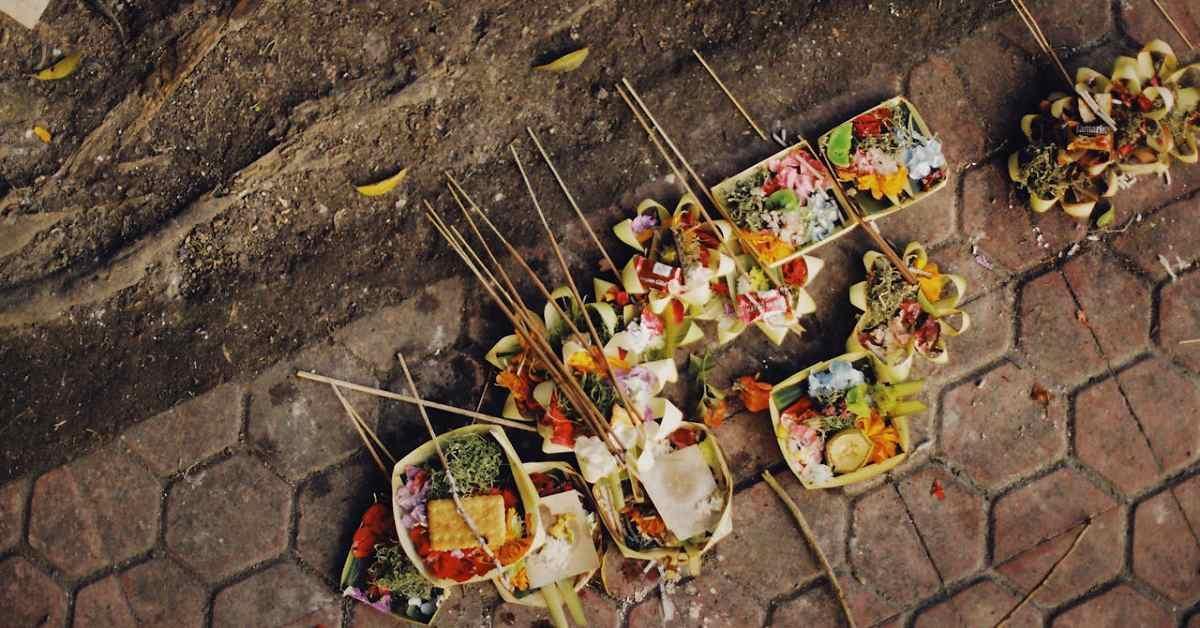
Atop this sits the sampian urasari, an ornamental disc of folded young coconut leaf that holds the flowers and is associated with the sun and divine power. Then come the flowers themselves, the most eye-catching and meaningful element, arranged not at random but as a “compass of prayer,” with each colour pointing in a cardinal direction to honour a particular deity. Finally, the offering is completed with a stick of incense (dupa), whose rising smoke is believed to carry the sari, the essence of the offering, up to the heavens, and often a coin or small note, a token of generosity and worldly goods.
What’s Inside a Canang Sari
| Component | Material | Symbolic meaning |
|---|---|---|
| Ceper | Woven young coconut leaf (janur) | The earth and the physical body |
| Porosan | Betel leaf, lime, and areca nut | The Trimurti (Brahma, Vishnu, Shiva); thought, speech, action |
| Wija | Uncooked white rice | Sang Hyang Atma, the soul or seed of life |
| Sampian urasari | Folded coconut leaf | The sun and divine power hold the flowers |
| Bunga (flowers) | Mixed coloured petals | The directional deities (see below) |
| Dupa | Incense stick | Carries the essence to the heavens; purifies |
| Kepeng / money | Coin or small note | The “sari” (essence), generosity, and worldly goods |
The Flowers: A Compass of Prayer
The placement of the flowers turns each canang into a color-coded prayer aligned with the directions and their guardian deities.
| Flower colour | Direction | Deity |
|---|---|---|
| White | East | Iswara |
| Red | South | Brahma |
| Yellow | West | Mahadeva |
| Blue or green | North | Vishnu |
| Central flower (often frangipani) | Centre | Shiva |
Because the symbolism rests on color and direction rather than a single species, Balinese families use whatever blooms grow around them, frangipani (jepun), marigold (gumitir), globe amaranth, and bougainvillea, among the most common, so long as the colors fit. The beauty and fragrance of the flowers are understood to express the sincerity and devotion behind the offering.
How a Canang Sari Is Made
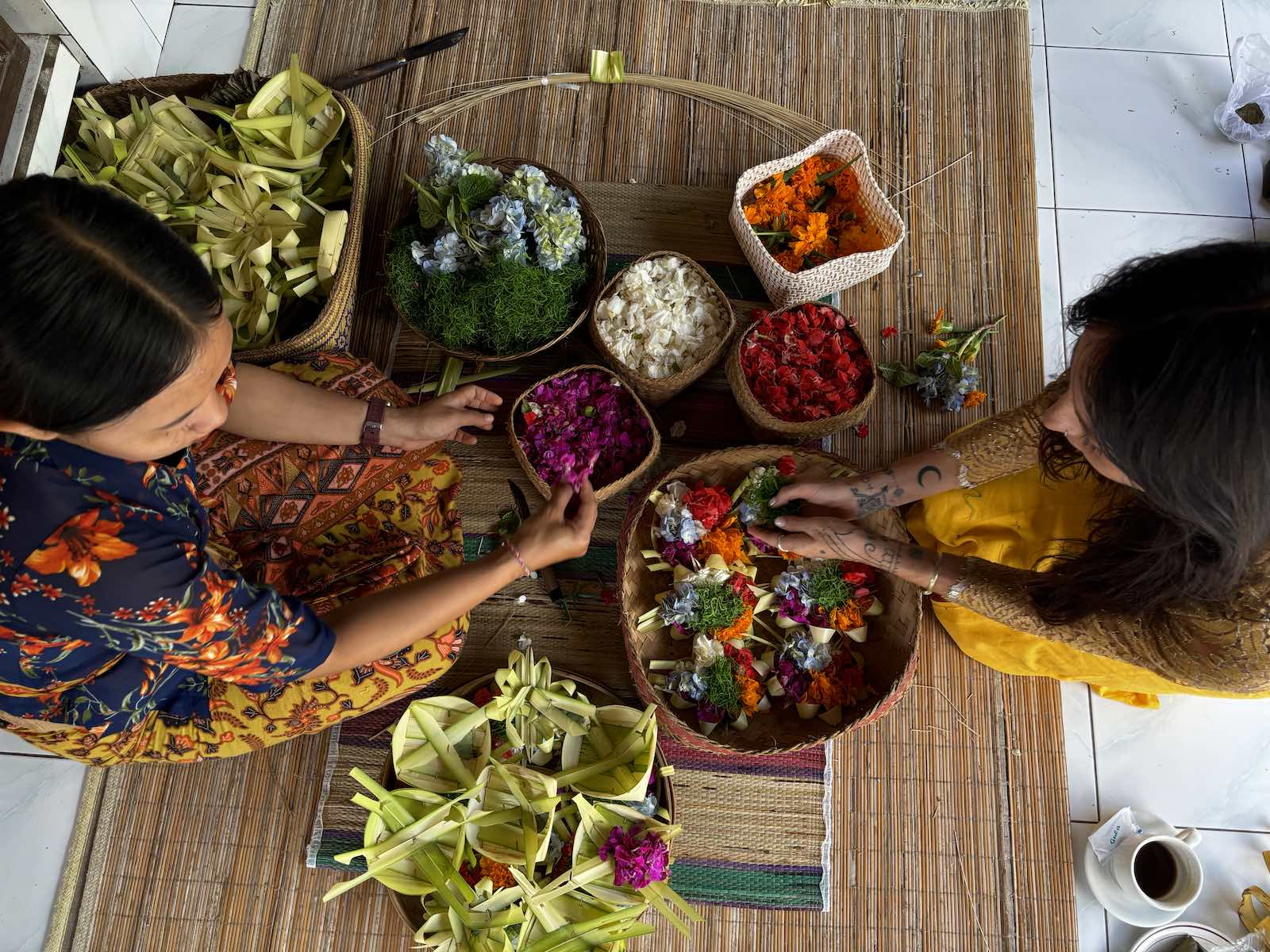
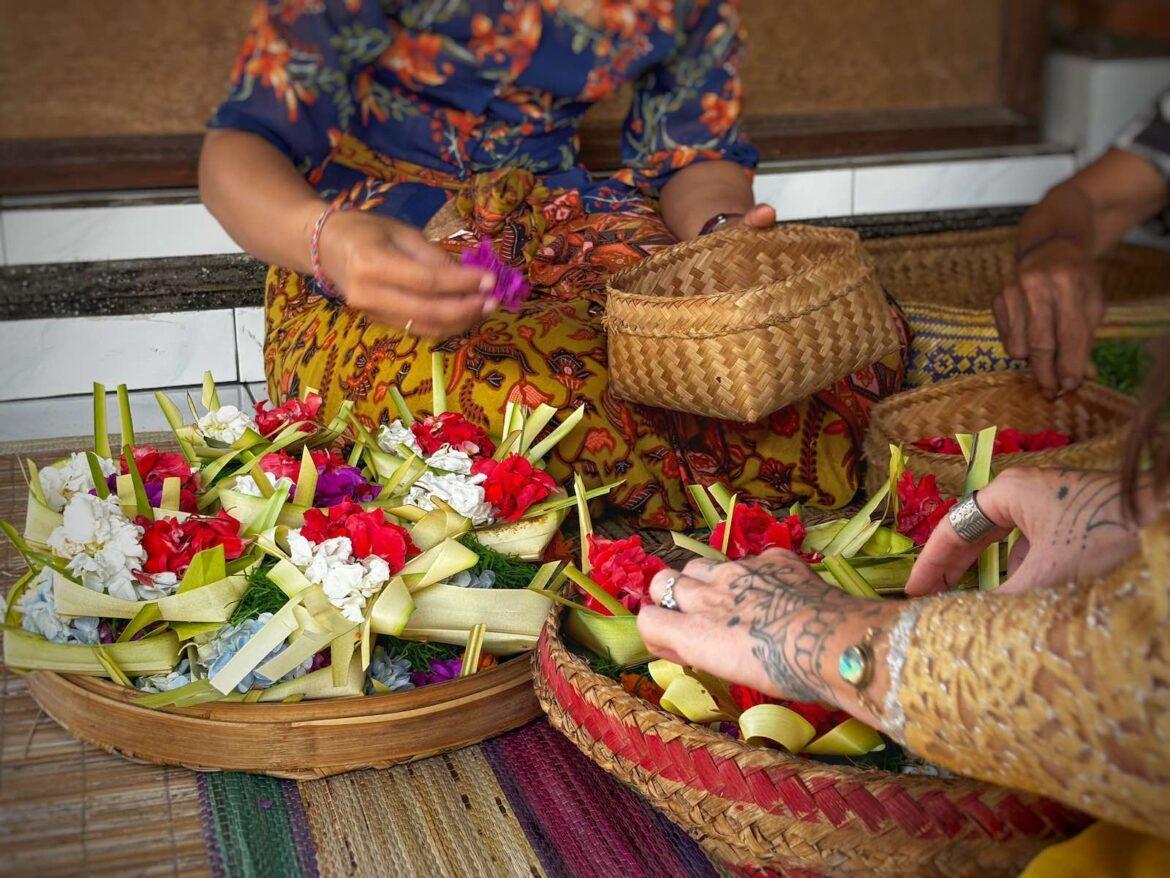
Making canang sari is a craft, a meditation, and a daily discipline rolled into one. It begins with the janur, strips of young coconut leaf, which are measured, folded, and pinned with tiny slivers of bamboo (semat) to form the square ceper base. The maker then assembles the layers in order: the porosan and rice at the heart, the sampian urasari on top, and finally the flowers, each color set carefully toward its direction. A few drops of fragrant oil may be added, and the canang is ready to receive its incense and be offered.
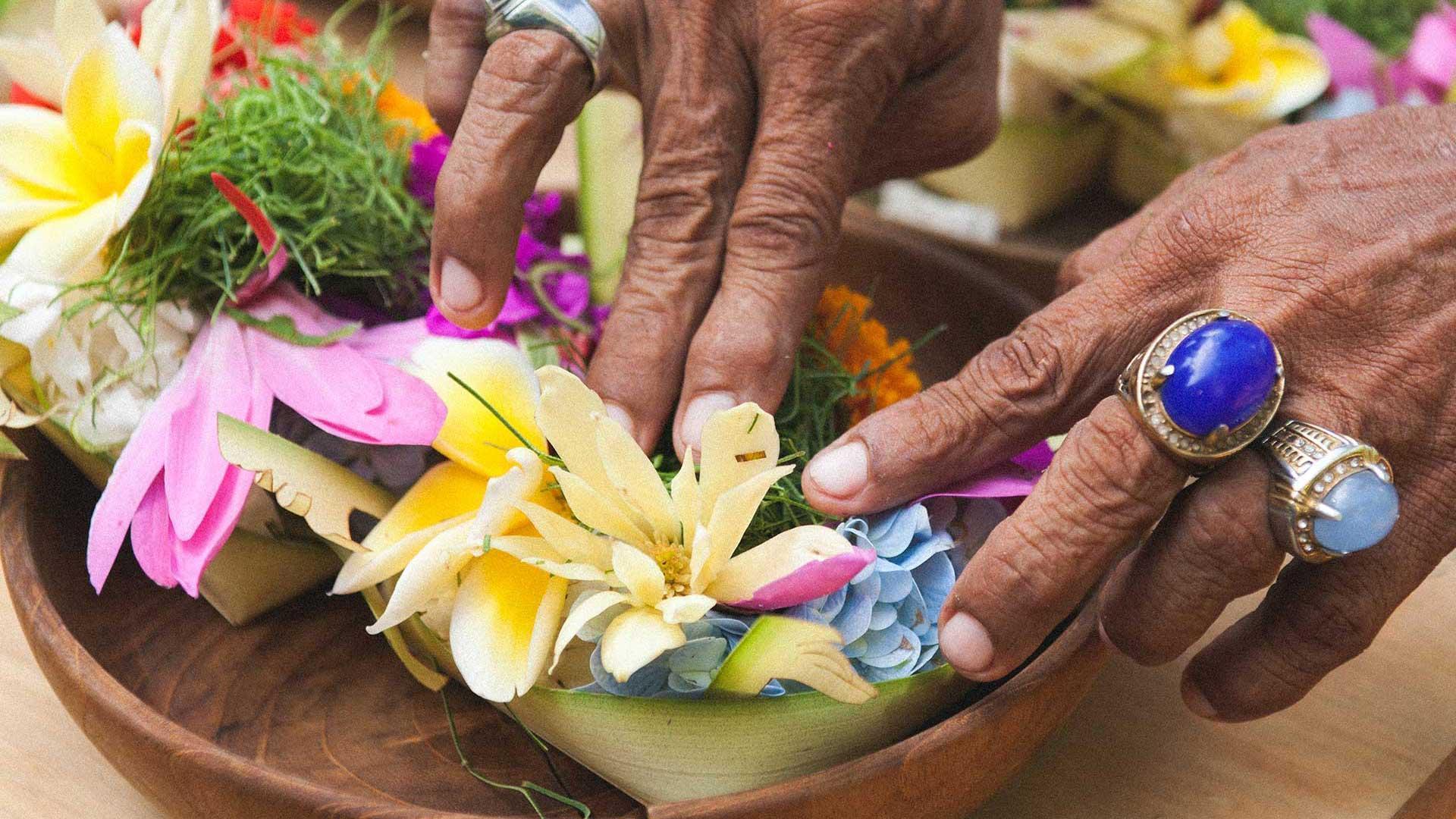
There is an unhurried rhythm to the work. For many Balinese, weaving canang is a form of moving meditation, a calming, repetitive practice that grounds the day. Traditionally it is the daily duty of Balinese women, many of whom make dozens of offerings each morning for their household, their shop, and their family shrine. The act of preparing something beautiful by hand, only to give it away in gratitude, is itself the point: the offering embodies a small, daily self-sacrifice of time and care.
It’s a discipline, not a quick craft project
Making canang sari combines craft, meditation, and daily discipline into a single practice — it isn’t a quick decorative task but something approached with the same regularity and intention as prayer itself.
That framing is worth keeping in mind if a resort or guide offers a canang sari-making activity: it’s meant as a genuine cultural practice, not a souvenir-making session.
Canang Sari in Daily Life in Sanur
In Sanur, canang sari is woven into the texture of everyday life. As one of Bali’s oldest settlements, home to the 913 AD Blanjong Pillar and a strongly traditional community, Sanur observes its spiritual rhythms faithfully. In the early morning, you will see freshly made offerings appearing along Jalan Danau Tamblingan, at the entrances to warungs and boutiques, on the shrines dotting the beachfront promenade, at temples such as Pura Blanjong, and at the thresholds of the resorts lining the sand.
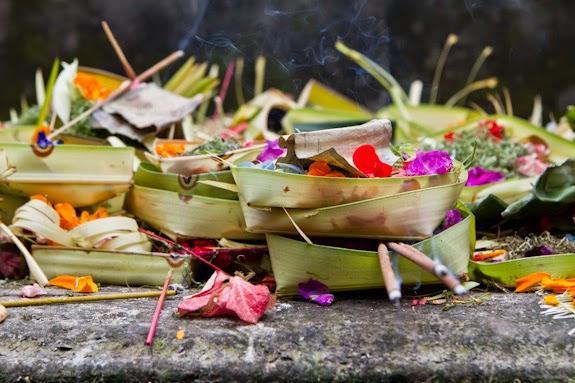
This is “spiritual housekeeping” in action, the daily maintenance of balance between the seen and unseen worlds. By late afternoon, the morning’s offerings have often been scattered by the breeze, nibbled by birds or stray dogs, or swept gently aside. This is not disrespect but the natural completion of the ritual: once the incense has burned out, the sari is considered received, the offering has served its purpose, and a fresh one will take its place tomorrow.
For visitors, understanding this rhythm is the key to moving through Sanur respectfully. The single most important rule is simple: never intentionally step on or over a canang sari placed on the ground.
The Philosophy: Why Balinese Make Offerings Every Day
To outsiders, the sheer frequency of canang sari can be astonishing, but it reflects a worldview in which the spiritual and the everyday are inseparable. The practice is rooted in the Hindu principles of karma and dharma: by making daily offerings, a person gathers good karma and fulfills their duty to maintain cosmic balance. The Balinese cosmos is understood as a constant negotiation between positive and negative forces, the divine and the earthly, the seen and the unseen, and the humble canang is one of the chief ways that equilibrium is kept.
This is also why the offering is treated as a quiet act of devotion rather than a grand gesture. Canang sari is not made when there is a death in the family or community, and it features in the broader cycle of Balinese ceremony, appearing on auspicious days such as Purnama (full moon) and Tilem (dark moon). In an age of modern pressures, the persistence of the practice, with office workers, shopkeepers, and drivers all pausing to make and place offerings, is itself a statement of cultural resilience.
There is a contemporary challenge worth noting, too. The use of plastic and non-biodegradable decorations in offerings has created environmental concerns, prompting many communities to return to wholly natural materials, palm leaves, bamboo, and organic flowers, in keeping with the palemahan principle of harmony with nature. Learning to make canang the traditional way is, in a small sense, part of preserving that balance.
Frequency is the point, not excess
To outsiders, the sheer number of daily offerings placed around Sanur can look excessive, but that frequency is itself the message — it reflects a worldview where the spiritual and the everyday aren’t separate domains requiring occasional special observance.
Understanding that reframes what a visitor sees on the street: not repeated ritual for its own sake, but a daily practice treated with the same regularity as any other part of life.
Learn the Art of Canang Making at The Meru Sanur
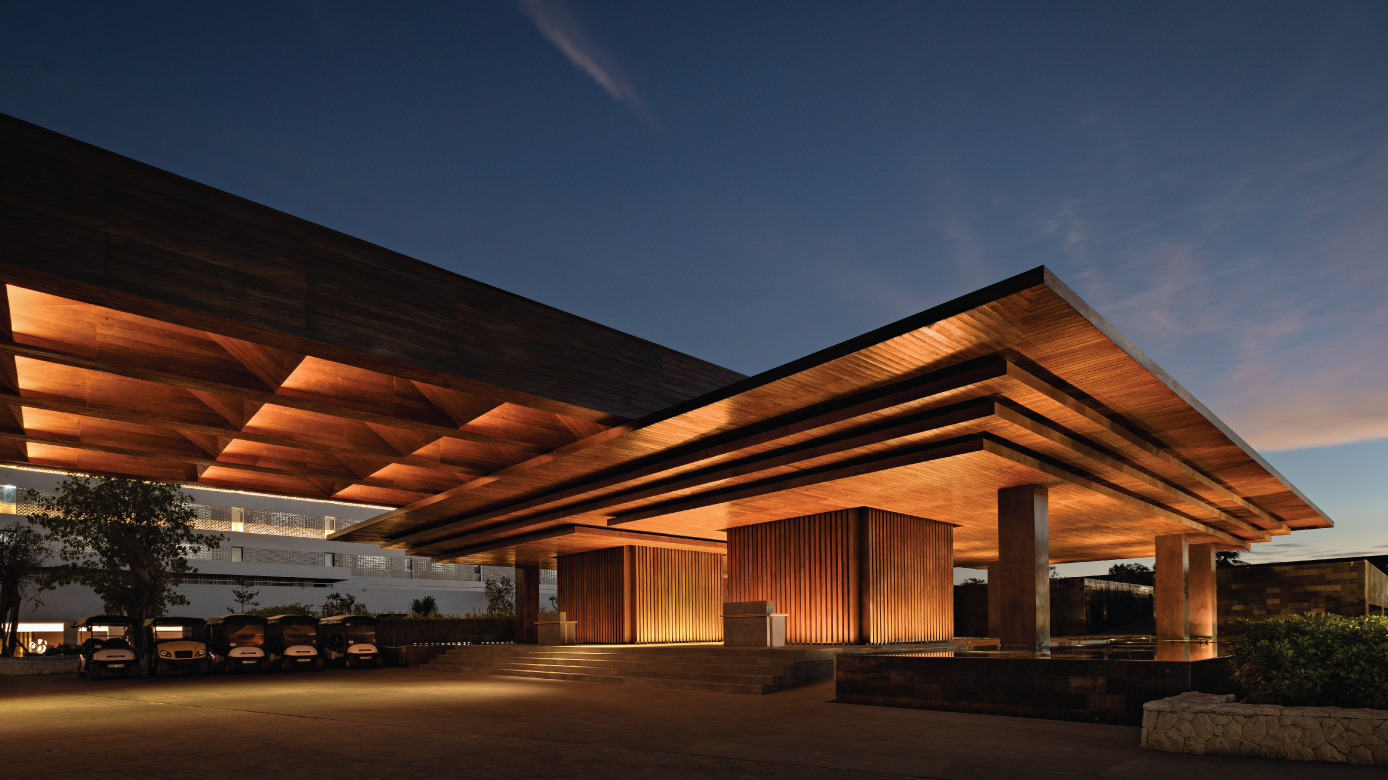
Reading about canang sari is one thing; folding the janur, placing each flower toward its direction, and feeling the meditative calm of the craft is another entirely. For travelers who want to move beyond observing into genuine understanding, The Meru Sanur, the all-suite beachfront resort on Sanur’s sunrise coast, offers an Art of Canang Making experience that invites guests to engage directly with this sacred tradition.
Guided by skilled local practitioners, the session teaches the fundamentals of canang creation using young coconut leaves and fresh flowers, from weaving the ceper base to arranging the color-coded blooms and understanding the meaning behind each element. It is a hands-on, mindful encounter with Balinese spirituality, and a beautiful way for visitors of all ages to connect with the island’s living heritage in the calm of a beachfront resort.
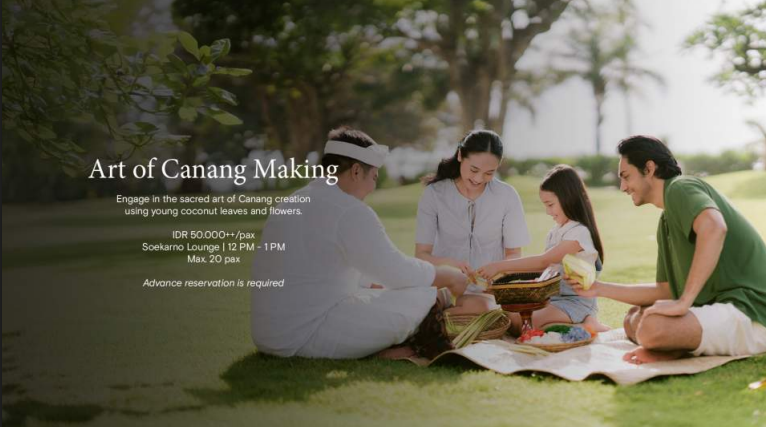
The experience reflects The Meru Sanur’s wider philosophy as “a haven of wellbeing,” where Balinese culture is woven into a stay rather than staged as a spectacle. Set within the 42-hectare Sanur Special Economic Zone for health and wellness tourism, the resort frames canang making as part of a broader journey into Balinese heritage, complementing its other cultural offerings and its five-senses wellness ethos.
Art of Canang Making at The Meru Sanur — Experience Information
- What it is: A guided session in the sacred art of canang creation using young coconut leaves and flowers
- When: Wednesdays, 11:00 AM – 4:00 PM Price: IDR 50,000++ per person
- Note: Advance reservation is required
- Where: The Meru Sanur, Sanur, Bali
*Prices are for reference only and may change without notice. Please contact us directly for current rates.
Tips for Respecting Canang Sari in Bali
Whether you are observing offerings in the street or learning to make one yourself, a little awareness honors the tradition and those who practice it:
- Never step on or over a canang. Offerings placed on the ground are sacred; walk around them.
- Don’t be alarmed by swept-up offerings. Once the incense has burned out, the essence is considered received, and remnants are cleared as a natural part of the cycle.
- Observe quietly during prayer. If someone is placing an offering or praying, keep your distance and your voice low.
- Ask before photographing people. A smile and a gesture toward your camera is courteous, especially for close-ups of someone making or offering canang.
- Handle offerings respectfully if you make your own. Approach the craft with the same care and intention that the Balinese bring to it.
- Favor natural materials. If you create canang, traditional palm leaf and fresh flowers honor the palemahan principle of harmony with nature.
Frequently Asked Questions
What is a canang sari?
Canang sari is the most common daily offering in Balinese Hinduism: a small woven coconut-leaf tray filled with colorful flowers, rice, and incense, presented as an act of gratitude to Sang Hyang Widhi Wasa (the supreme God) and the guardian deities. The name means roughly “the essence of a beautiful purpose.”
What does each part of a canang sari mean?
Every element is symbolic. The woven base (ceper) represents the earth and body; the betel-and-lime bundle (porosan) honors the Trimurti of Brahma, Vishnu, and Shiva; a pinch of rice (wija) represents the soul; the flowers, arranged by color toward the cardinal directions, honor the directional deities; and the incense (dupa) carries the offering’s essence to the heavens.
Why do the flowers face certain directions?
The flower colors and their placement form a “compass of prayer.” White faces east for Iswara, red faces south for Brahma, yellow faces west for Mahadeva, blue or green faces north for Vishnu, and a central flower honors Shiva. The arrangement aligns the offering with the directional deities to maintain cosmic balance.
Who makes a canang sari?
Traditionally, making canang sari is the daily duty of Balinese women, many of whom prepare dozens each morning for their homes, shrines, and businesses. It is regarded as both a devotional act and a meditative craft.
Can tourists learn to make canang sari?
Yes. Canang-making workshops are a wonderful way to engage with Balinese culture. In Sanur, The Meru Sanur offers an Art of Canang Making experience on Wednesdays from 11:00 AM to 4:00 PM, priced at IDR 50,000++ per person, with advance reservation required.
Is it rude to step on a canang sari?
Yes. Intentionally stepping on or over a canang sari placed on the ground is considered disrespectful. As you walk through Sanur or anywhere in Bali, simply step around them. If you accidentally disturb one, a quiet, respectful acknowledgment is enough.
Why are canang sari left on the ground and then swept away?
Offerings placed on the ground are intended for the lower spirits and the earthly realm, part of maintaining balance. Once the incense has burned and the essence has been received, the physical offering has served its purpose, so remnants are naturally cleared or scattered, and a fresh canang is made the next day.
*Prices are for reference only and may change without notice. Please contact us directly for current rates.
Final Thoughts
Canang sari is Bali distilled into a single, fragrant gesture: a small, beautiful thing made by hand each day and offered in gratitude, holding within it an entire philosophy of balance among people, nature, and the divine. To learn canang-making in Sanur is to slow down and participate in that philosophy rather than simply admire it from the outside, folding the coconut leaf, placing each flower with intention and understanding, and, finally, understanding what those countless little baskets along the promenade truly mean. Experienced mindfully, whether on a quiet Sanur street or in a guided session at The Meru Sanur, it is a moment of connection that lingers long after the incense has faded.